Dara knot tattoos
A Dara knot tattoo is an interlaced design inspired by oak roots, usually read as inner strength. Its name comes from the Irish word for oak, but the knot itself is modern.
66 designs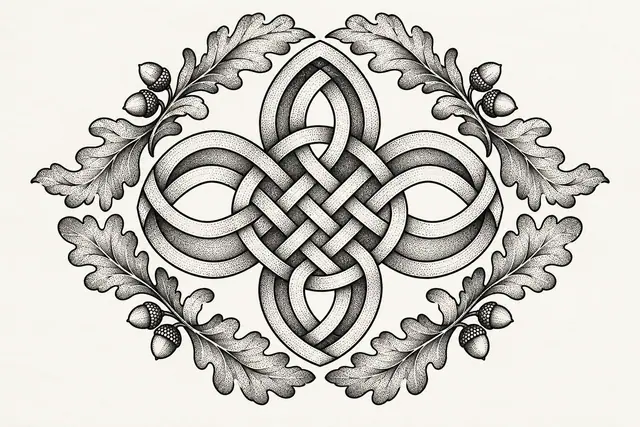
What the Dara knot is
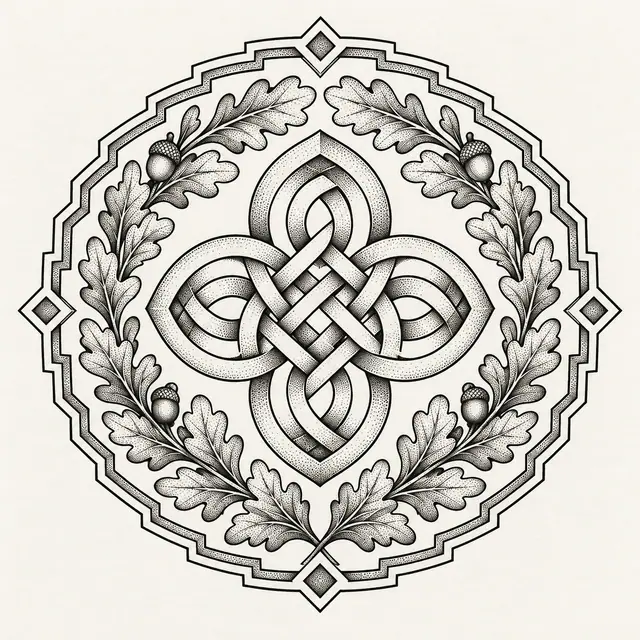
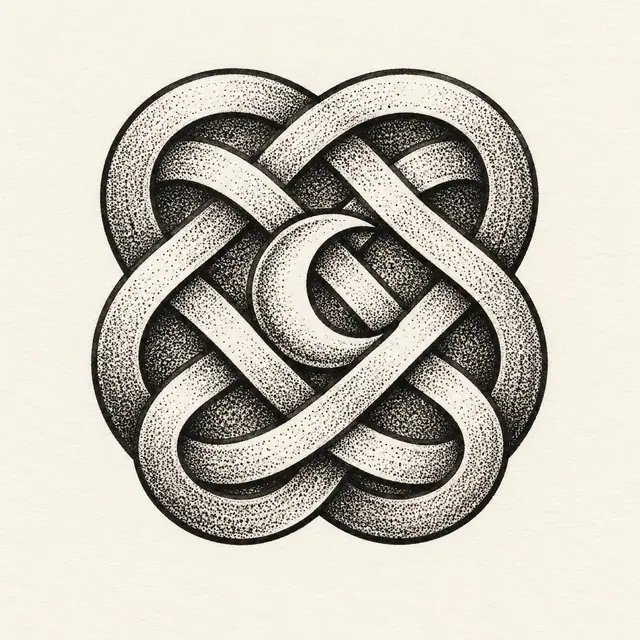
The Dara knot is an interlaced knot usually drawn as a closed, rounded or shield-like shape, with strands that loop inward and downward in a way meant to suggest the root system of an oak. Many versions have a strong vertical axis, like a trunk, with loops spreading on either side. There’s no single fixed form, so you’ll see a lot of variation from one artist or jeweler to another.
Since it’s built like any other piece of Celtic knotwork, the same quality checks apply. The strands should alternate over and under without exception, stay an even width, and leave gaps of roughly equal size. Because Dara knots often have several crossings packed into the center, check that part closely on the stencil. If the center looks dark and busy on paper, it will look darker and busier on skin in ten years.
Where it actually comes from
This is the part many websites skip, so here it is plainly: the Dara knot is a modern design. There’s no known Dara knot in the Book of Kells, on Pictish stones, on Irish high crosses or in La Tene metalwork. It seems to have emerged in recent decades through Celtic jewelry and tattoo design, drawn in the style of Insular knotwork.
The name is genuinely Irish. It’s tied to dair, the Irish word for oak, and doire, an oak grove or oak wood. Doire is the source of the place name Derry, and Kildare comes from Cill Dara, “church of the oak.” The letter D in the Ogham alphabet is also named dair. You can see how your own name looks in that script with our Ogham converter.
Oaks were clearly valued in early Ireland. Sacred trees, called bile, stood at important sites, and oak shows up often in place names. But the step from “oaks mattered” to “here is the ancient oak knot” is one the evidence doesn’t support. Saying so isn’t a criticism of the design. Plenty of meaningful symbols are new, and a Dara knot drawn with care is a fine tribute to an old Irish love of oak.
What it is commonly taken to mean
| Reading | Status |
|---|---|
| Inner strength and resilience | Popular modern reading |
| Endurance through hardship | Popular modern reading |
| Deep roots, family and ancestry | Popular modern reading |
| Wisdom and steadiness | Popular modern reading |
| Oak as a valued tree in Ireland | Supported by place names and early sources |
The strength reading is the one most people intend. It’s common to choose a Dara knot after recovering from illness, losing someone, or getting through a difficult few years. Some people choose it for a parent or grandparent who was the steady one in the family.
Because the design is modern, you also have more freedom than with older symbols. There’s no single correct version to match, so you and your artist can adjust the shape: lengthen it to fit a forearm, round it into a circle for a shoulder, or work a loved one’s initial into the center. Just keep the over-under weave intact, since that’s what makes it read as Celtic knotwork rather than a loose doodle.
Design choices
Blackwork suits the Dara knot’s sense of weight and solidity. Thick, solid strands look like carved oak and stay readable.
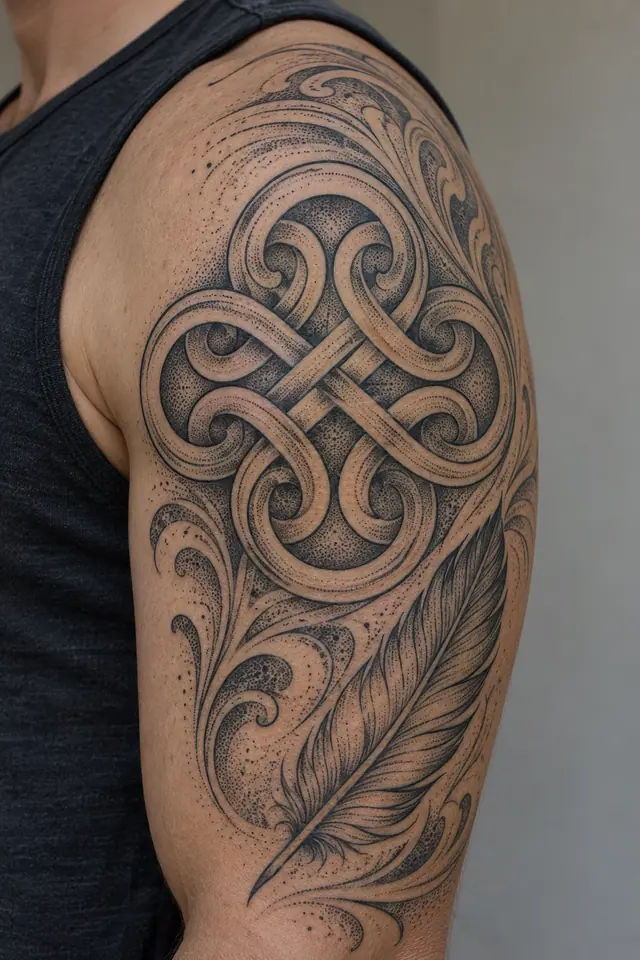
Outlined ribbons with wood-grain or dotwork texture inside the strands are a nice nod to the tree. Dotwork fill like this softens the knot without losing its outline.
Fine-line versions can look elegant, but choose a design with fewer crossings so the center doesn’t close up.
Color works well in earthy tones: deep brown strands with green oak leaves at the edges, or a single green for Irish heritage.
Woad-blue gives a quiet, old-world feel and pairs well with a simple outline.
Placement and size
- Wrist or ankle: about 1.5 inches, simple version with few crossings.
- Inner or outer forearm: 2-3 inches, the most popular placement. Browse our forearm designs.
- Upper arm or shoulder: 3-4 inches, room for a circular frame or oak leaves.
- Over the heart: a fitting spot if the knot honors a person.
- Upper back or between the shoulders: 3-5 inches, good if you want to build more around it later.
The knot’s vertical, root-like shape suits the forearm and the back of the calf. If your version is very symmetrical, choose a flatter area so it doesn’t warp when you move.
Pairing it with other symbols
The Dara knot pairs most naturally with the tree of life, since both draw on trees and roots. One option is to place the Dara knot at the base, like a root system, with a tree growing from it. Acorns and oak leaves fit around the edge without much added detail. An Ogham name running vertically beside the knot echoes the way Ogham was cut along the edge of standing stones. If you’re combining a few elements, our guide on how to design a Celtic tattoo can help you plan the layout.
Dara knot tattoo designs
Questions people ask
What does a Dara knot tattoo mean?
It is generally read as strength, endurance and steadiness, drawing on the oak and its deep roots. People often choose it after a hard period in life, or to honor someone who held the family together.
Is the Dara knot an ancient Celtic symbol?
No. There is no known example in early Irish manuscripts, carvings or metalwork. It is a modern design built in the style of Insular knotwork, and its name comes from Irish words for oak.
What does Dara mean in Irish?
The name is linked to the Irish dair, meaning oak, and doire, meaning oak grove. Doire is the root of the place name Derry. Dara is also used as an Irish personal name.
What size should a Dara knot tattoo be?
Simple versions work at about 1.5 inches. Designs with many crossings or a circular frame need 2.5-3 inches or more so the interlace stays clear as the tattoo ages.
Related symbols
 Celtic knotUnbroken interlace, read today as eternity and connection.
 Trinity knotThree interlocked arcs, best known as the Holy Trinity.
 TriskeleA triple spiral that is older than the Celts themselves.
 Tree of lifeRoots that mirror branches: growth, family and balance.
 Celtic crossThe ringed stone cross of early medieval Ireland.
 CladdaghHands, heart and crown from 17th-century Galway.
 Shield knotA four-cornered knot worn for protection.
 Motherhood knotA modern knot of two hearts, for parent and child.
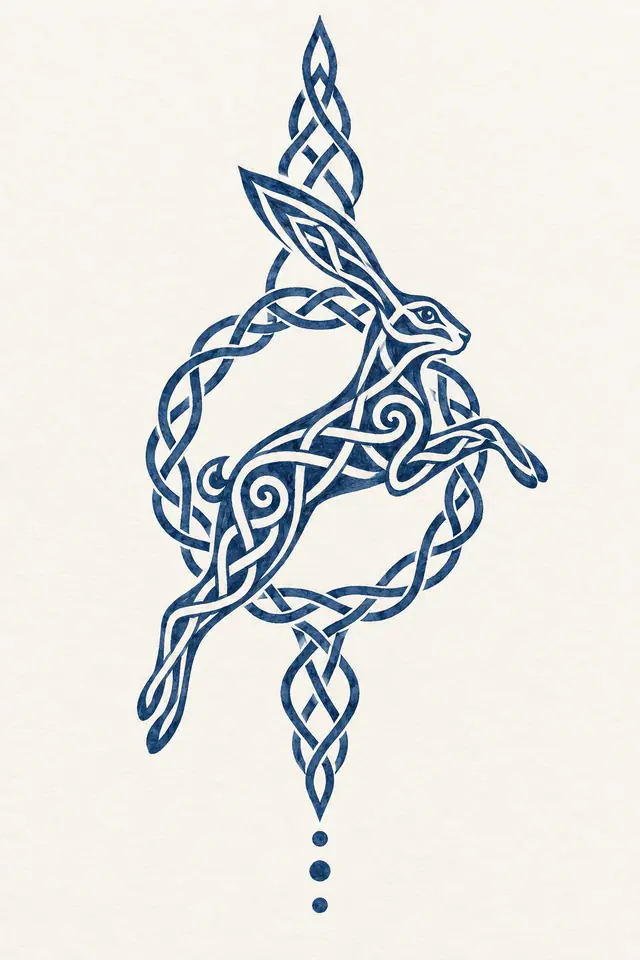 Celtic animalsWolves, stags, ravens and salmon woven into interlace.