Claddagh tattoos
A Claddagh tattoo shows two hands holding a crowned heart: hands for friendship, heart for love, crown for loyalty. It comes from 17th-century Galway, so it is Irish rather than ancient Celtic.
70 designs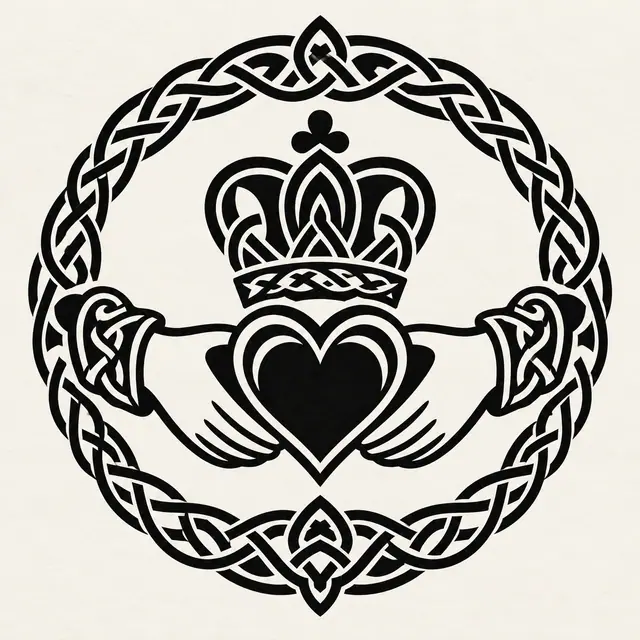
What the Claddagh is
The Claddagh is a design of two hands clasping a heart, with a crown resting on top of the heart. It started as a ring, and the ring is still how most people know it. As a tattoo it keeps the same three elements, sometimes with knotwork, lettering or color added around them.
Each part has a fixed meaning that almost everyone agrees on:
| Element | Meaning |
|---|---|
| Hands | Friendship |
| Heart | Love |
| Crown | Loyalty |
What makes a Claddagh tattoo work is the hands. Fingers are small, repeated shapes, and if they’re drawn too thin or packed too close, they merge into a lump within a few years. Look for an artist who simplifies the fingers into clean, distinct shapes and leaves skin visible between them. The heart should sit clearly in front of the hands, and the crown should be centered and not overloaded with tiny points.
Where it actually comes from
The Claddagh is named after the old fishing village of Claddagh, just outside the walls of Galway city in the west of Ireland. The ring tradition dates to the 17th century.
The best-known origin story involves Richard Joyce, a Galway man said to have been captured at sea and sold into slavery in North Africa, where he trained as a goldsmith. When he was eventually freed and returned to Galway, he is said to have brought the design with him and made the first Claddagh rings. It’s a good story, and some early rings do carry a maker’s mark linked to Joyce, but the details of his life come down to us mostly as legend. Treat the romantic version as tradition rather than documented history.
The design itself belongs to a wider European family of “fede” rings, which show two clasped hands, a style that goes back to Roman times. The Claddagh adds the heart and crown.
This matters for anyone wanting celtic tattoos with deep roots: the Claddagh is Irish, and proudly so, but it is not ancient Celtic. It has nothing to do with Iron Age art or medieval manuscripts. That doesn’t make it any less meaningful. It means you’re wearing a few centuries of Galway tradition rather than a few millennia.
What it is commonly taken to mean
Beyond the three elements, a set of customs grew up around how the ring is worn:
- Right hand, heart pointing out: single.
- Right hand, heart pointing in: in a relationship.
- Left hand, heart pointing in: engaged or married.
These customs are popular and widely repeated, though they vary from family to family. A tattoo can’t be flipped the way a ring can, so most people just place the Claddagh upright. If the direction matters to you, decide before the stencil goes on.
As a tattoo, people commonly use the Claddagh for a partner, a parent, a group of friends, or as a quiet sign of Irish family ties. Matching Claddagh tattoos between friends or siblings are common, since friendship is literally built into the design.
Design choices
Fine-line is the most popular style today. It suits the delicate ring look, but keep line spacing open around the fingers. Ask to see healed fine-line work, not just fresh photos.
Blackwork gives a bold, jewelry-engraving feel and ages best on hands and wrists.
Color works well here: a red heart, a gold crown, or a green heart for Ireland. A birthstone color inside the heart is a nice personal touch.
Dotwork shading on the heart and crown gives a metal-like gleam without solid fill.
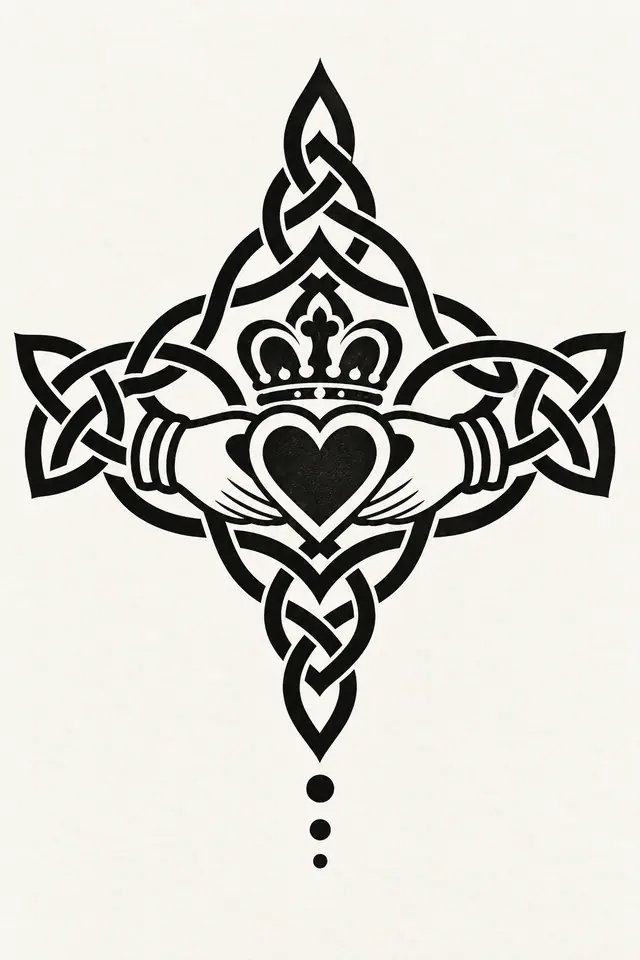
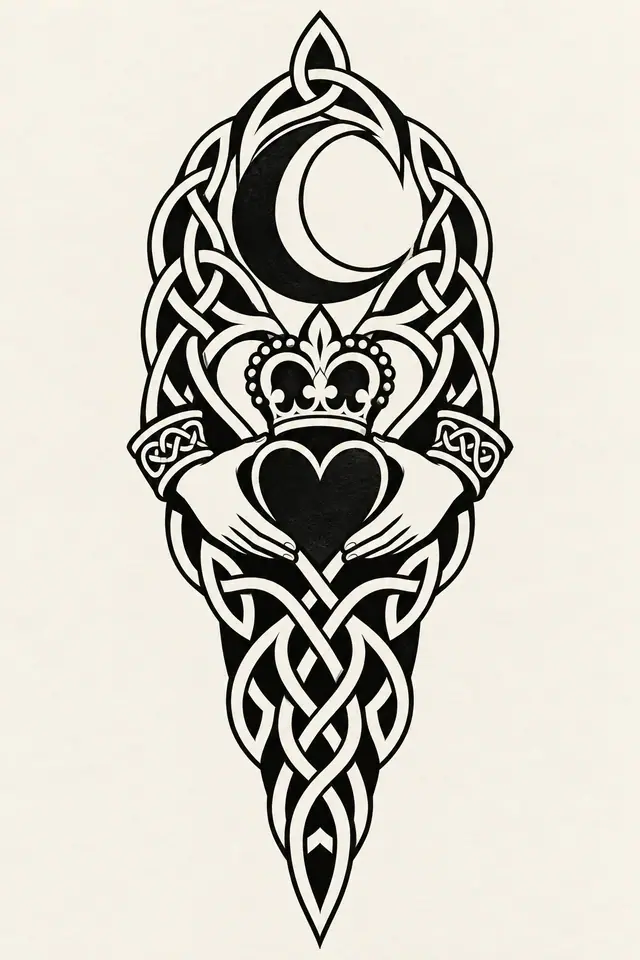
Knotwork additions are how you make a Claddagh read as “Celtic.” A trinity knot inside the heart or a band of interlace below the hands works well, but it adds detail, so size up.
Placement and size
- Wrist: about 1.5 inches tall is the practical minimum with recognizable fingers. Below that, simplify to an outline. See our wrist designs.
- Inner forearm: 2-3 inches, room for knotwork or a name.
- Over the heart or on the chest: a natural spot for a design about love.
- Behind the shoulder or upper back: good for larger versions with added knotwork.
- Ring finger: popular as a ring substitute, but fingers fade quickly and blur. Keep it to a bold outline and plan on touch-ups.
Hands and fingers also hurt more and heal less predictably than forearms. Our guide on cost, pain and aftercare has more on what to expect.
Pairing it with other symbols
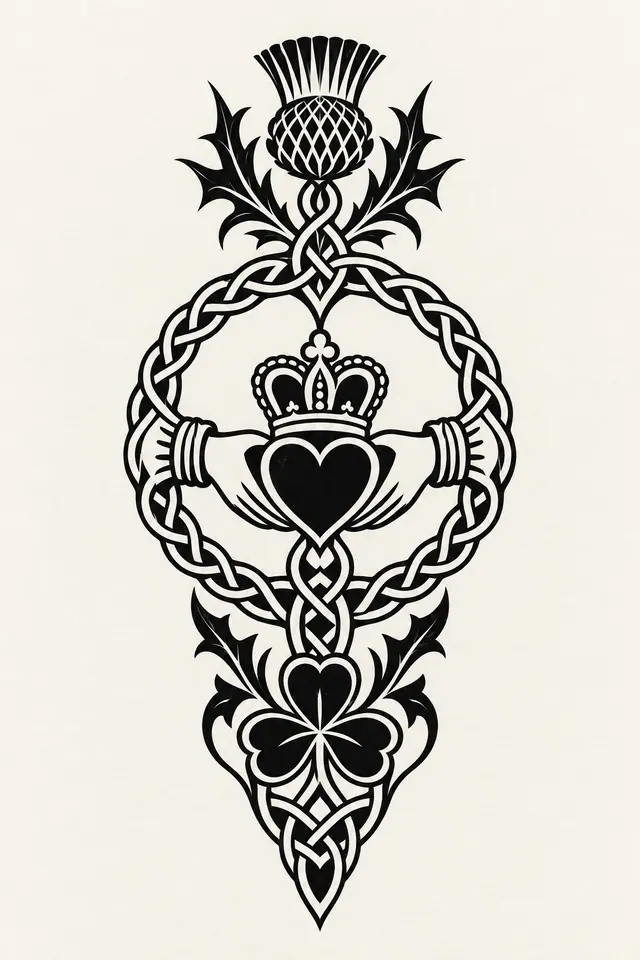
The Claddagh pairs easily with a Celtic knot border or armband, giving it a frame that ties it to older Irish art. Names fit well in a banner beneath the hands, or written in Ogham around the design; our Ogham converter shows how a name looks. Couples sometimes split the design, with one hand each, though think hard before getting half of anything.
If you want the Claddagh to feel weightier than a ring drawn on skin, a thin knotwork circle around the whole design helps without crowding the fingers. Leave at least 2-3 mm of bare skin between the circle and the hands so the two don’t merge as the lines soften.
Claddagh tattoo designs
Questions people ask
What does a Claddagh tattoo mean?
The hands stand for friendship, the heart for love and the crown for loyalty. People get it for a partner, for family, for close friends or simply for Irish heritage.
Which way should a Claddagh tattoo face?
With rings, custom says heart pointing toward you means your heart is taken and heart pointing out means you are open to love. A tattoo can't be turned around later, so most people simply place the heart upright as you would read it.
Is the Claddagh an ancient Celtic symbol?
No. It comes from the fishing village of Claddagh in Galway, and the ring tradition dates to the 17th century. It is a genuine Irish tradition, just a much younger one than the knots and spirals usually called Celtic.
Can I get a Claddagh tattoo on my finger?
You can, but finger tattoos fade and blur faster than almost anywhere else because the skin is thin and used constantly. Keep it very simple, expect touch-ups, and consider the wrist or inner forearm for a longer-lasting piece.
Related symbols
 Celtic knotUnbroken interlace, read today as eternity and connection.
 Trinity knotThree interlocked arcs, best known as the Holy Trinity.
 TriskeleA triple spiral that is older than the Celts themselves.
 Tree of lifeRoots that mirror branches: growth, family and balance.
 Celtic crossThe ringed stone cross of early medieval Ireland.
 Shield knotA four-cornered knot worn for protection.
 Dara knotA modern knot inspired by the roots of the oak.
 Motherhood knotA modern knot of two hearts, for parent and child.
 Celtic animalsWolves, stags, ravens and salmon woven into interlace.